
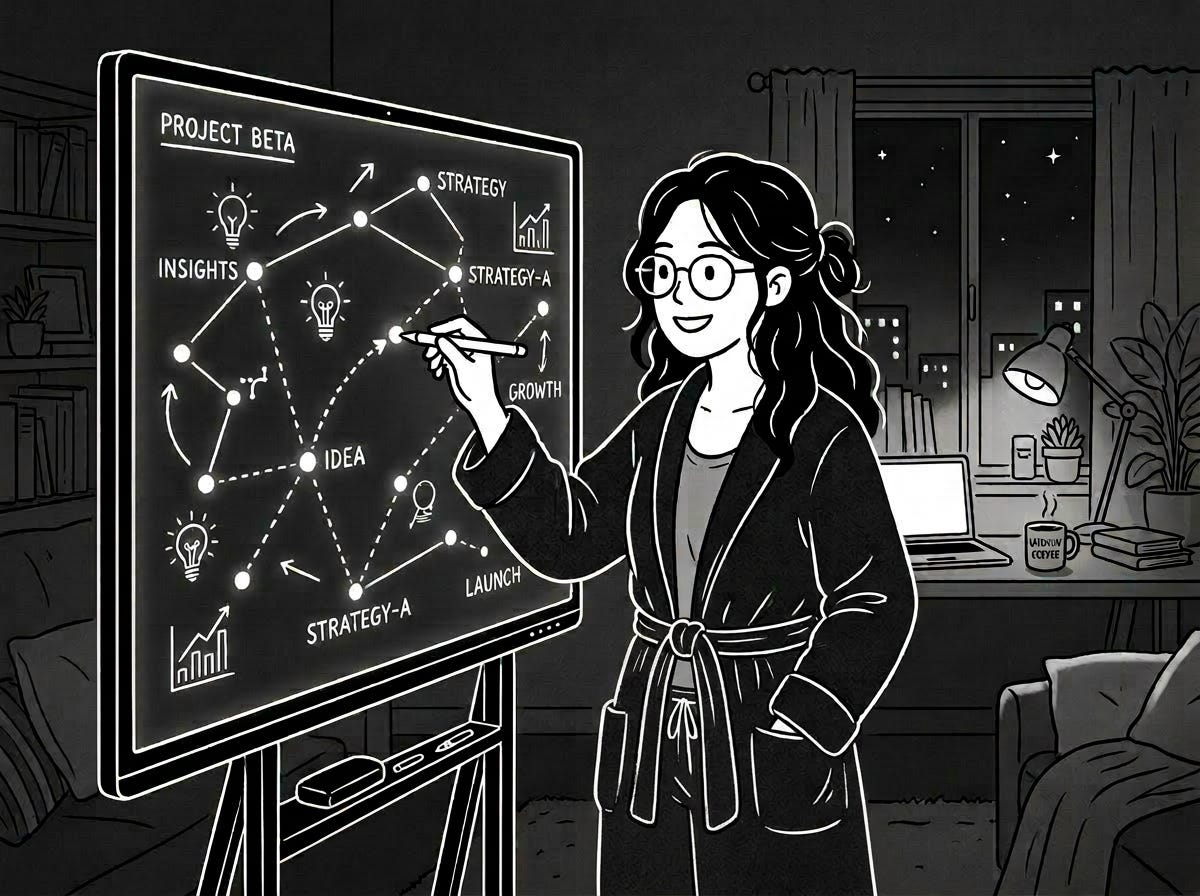
I am learning two different subjects simultaneously, and my brain is protesting.
Late at night, I sit with Mao’s Great Famine—an eye-opening account of the Great Leap Forward—while also attempting to master Obsidian, a networked note-taking system. The technical aspects of linking notes are starting to click. I have created notes for Mao Zedong, the Chinese Communist Party, the 1958-1962 date range, Frank Dikötter (the author of the book), and “Archives” (since the book draws heavily on archival documents). In the graph view, I can see the constellation forming: Mao connected to the Party, Dikötter linked to Archives, the timeline tethered to the Great Leap Forward.
Yet, I am reading sentences three, four, five times, and still watching them slide through my mind like water through a sieve. It is the reading equivalent of “in one ear and out the other”—in one eye and out the other. Part of this is circumstantial. It is late, I am tired, and my attention span feels frayed. But part of it is the cognitive load of learning a devastating history while at the same time figuring out how to organize its various facets in a way that I can wrap my head around.
The Rabbit Hole Temptation
My vocabulary is failing me, or perhaps the text is simply dense. I find myself encountering unfamiliar terms in the preface alone. The instinct is to stop, consult ChatGPT or a dictionary, and create a new note for every concept. I have already linked one term to a Disney movie character because the definition triggered that association.
But if I look up every word, create a note for every concept, and follow every rabbit hole, I will be reading this book for years. On the one hand, there is the desire for a comprehensive understanding of the material. On the other hand, there is the reality of finite time. I catch myself wanting to “cover” pages rather than absorb them, driven by an anxiety that there are so many other books waiting.
The Breakthrough
Later that evening, I attempted to explain to my husband what I had learned so far, fully expecting to stumble over my words. I’ve always considered myself to be more of a writer than a speaker.
But something unexpected happened. I found myself articulating the concepts with a clarity that surprised me. I understood the material better than I had realized. The slow and repetitive reading, the obsessive lookups, the linking of different ideas; it had all sunk in deeper than the “in one eye and out the other” sensation suggested.
The Case for Slowness
This forced me to reconsider my impatience. When I was studying Mandarin in Taiwan, the words that stuck were the ones I struggled with—the characters I wrote over and over again, the phrases I researched and butchered. The words I glossed over were the ones that disappeared from my memory. Depth required friction.
Perhaps this is simply how learning works, especially for complex, emotionally weighted material. The historical devastation I am studying demands comprehension, not coverage. My brain is building new pathways, and construction takes time. I cannot expect to speed through the foundations and still expect the structure to hold.
Quality Over Quantity
I am trying to be brutally honest with my note-taking process. Before I create a link or capture a detail, I ask myself: Will I remember this? Does this matter in the grand scheme of things? I’ve found this necessary when I’m fighting the instinct to transcribe linearly and instead trying to trust the network of ideas to hold what is essential.
Will my methods be adjusted as time passes? Maybe. But for now, I am choosing depth over speed. The book will most likely take longer to finish. The notes will (hopefully) be fewer but denser. And when I close the app and try to explain what I have learned to someone I love, I hope to do so accurately without sounding like I’m simply reciting facts from a textbook.