
Recently, I went down the rabbit hole of trying to find the right film camera for me. This purchase is not one that I take lightly. I know, that sounds really dramatic, but if you knew the journey I’ve had with photography over the past nearly two decades, I think you would understand. So, for context, let me tell you a story.
The Portraits I Was Proud Of
In my junior year of high school, I joined a multimedia academy where we learned skills like photography, videography, graphic design, and audio production. It was awesome. I remember enjoying photography a lot, and our class assignments resulted in a number of shots that I can say I was genuinely proud of. A few of them included portraits of a classmate who sadly passed away during my first year in the program, so when it came to what photographs meant to me, it wasn’t just about aesthetics. There was an emotional connection to the art itself and a love for preserving memories in a beautiful way.
Too Many Interests, Not Enough Hours
But then, life did what it often does. It gave me several other activities and interests to give my attention to. It also doesn’t help that I have way too many interests. I tend to focus on one or two until I become proficient, but instead of continuing to level up in my skills, I move on to the next. If I could work on all of my interests at the same time, I absolutely would. However, there’s only so much time in a day, and my logic during my last few years of high school was that I needed to prioritize activities and interests that would help me earn a living. Since I wasn’t planning on becoming a professional photographer, my love for the art form was placed in the backburner for a while.
Also, I didn’t think I was skilled enough at photography to turn it into a source of income. Enter the comparison trap. I was surrounded by wildly talented individuals (both inside and outside of school). I thought they had the potential to earn a living off of the skill, but since I wasn’t at their level, I figured there was no point in me even trying to master it. On the one hand, it probably wasn’t entirely wrong for me to not take photography so seriously since it is an investment, and I was a student with no job. On the other hand, even if I wasn’t planning on becoming a professional photographer, I could’ve been better about avoiding negative self-talk and having more confidence in my ability to master photography through hard work.
Back In, with a Mirrorless
Once I got older and reached the point of earning my own income, I guess I could’ve invested more of my time and energy into the craft. But by then, my interest had waned. I had developed other passions that were more important to me than photography at that stage in my life. Years went by. Instagram became a thing, so I started documenting parts of my life by taking pictures with my phone and posting heavily filtered versions of them online. Eventually, I got off the app and didn’t get back on until nearly a decade later. During the time period I was off social media, I would take photos for my own personal memories, but I dove back into the world of photography when my husband and I started posting food and travel-related content on a joint Instagram account.
I really wanted to take high-quality photos, so we invested in a mirrorless camera, and I went down a rabbit hole of watching YouTube tutorials on digital photography techniques so I could fully utilize the specific camera that we bought. Honestly, learning and putting into practice what I learned was so much fun for me. I actually kept at it for quite some time, until I didn’t. Taking pictures of food slowly but surely became a lot less exciting for me, and once again, my interest in photography fizzled out. It got to a point where the mirrorless camera was just taking up space in our home, so we either sold it or gave it away. I honestly can’t remember.
Chasing the Film Look Without the Film
At some point before purchasing the mirrorless camera, though, I bought an Instax camera to be able to take vibey analog photos with friends. But later on, after getting rid of the mirrorless camera, I started wanting to take more photos with my Instax camera outside of the ones I took with other people. So, I spent more time outside trying to take landscape photos with it. I very quickly realized that it wasn’t the best camera for that purpose. Of course, I didn’t expect the quality of the photos taken with an Instax to be the same as those taken with a digital camera. But after some experimenting, I understood why it was primarily used for fun pictures with people.
Then I was introduced to the Camp Snap. That was an interesting one, and it was affordable, so the purchase didn’t make me sweat. It mimicked the look and feel of a disposable film camera in the sense that it was screen-free, and you couldn’t see your photos immediately after taking them. You had to look through a viewfinder, and you could pre-select filters that would make the photos look like they were taken with a disposable camera. But the way you choose a filter and view your pictures is by connecting the camera to your computer. So, although it was lower-quality, it was still digital. I had fun with it for a while, but I didn’t like that I kept having to crop the photos before posting them online. So, I gave it away and began my search for an app (or filter) that made photos taken with my phone appear as though they were taken with a film camera. My logic was that using my phone makes photography more accessible, and so with less friction, I would be more likely to stick with the hobby and not waste money on gadgets that I’d eventually get rid of.
That’s when I stumbled upon the OldRoll app, which (to their credit) does mimic the look of film photos pretty well, so I was consistent in photographing with it for a while because I was genuinely happy with the way several of the pictures came out. It’s an impressive app (in my opinion), but there was always a part of me that wanted to be able to produce the real thing. A friend of ours who is very skilled at film photography recently told us that he found out about a photo lab in a neighboring city that develops the film and emails the scans within one hour. He also mentioned that you could purchase some relatively inexpensive, used film cameras on websites like eBay, which led me down the rabbit hole that I mentioned at the very beginning of this newsletter issue.
Deciding What I Actually Wanted
So, here I am again. But this time, I’m trying to take film photos with an actual film camera. The thing is, though, I know myself and I’m well aware of my long history of starting and stopping this hobby. It’s hard to say how often or how long I’ll actually use the camera once I have it. I’d like to avoid wasting money if at all possible. So, I started off by thinking about what kind of photos I would want the camera to produce, and I came to the conclusion that I want a camera that natively shoots in a 3:4 (or 4:3) aspect ratio. That way, I can compose each shot exactly the way I want to. And if I decide to post any of my photos online, I won’t need to crop them. That’s when I learned about half frame film cameras, so that helped narrow down my options.
But now comes the issue with the viewfinder. I want accuracy, so I was thinking I’d need to go with an SLR. I also wanted something with a light meter. While continuing to go down the research rabbit hole, I came across the Olympus Pen FT, and I was convinced that was the model for me. The used options I found online weren’t insanely expensive, and it would give me the ability to shoot manually if I started really getting into it. But that’s just it: only IF I really get into it. While not terribly pricey, it is still an investment. I found one on eBay in pretty good condition that would’ve needed to be shipped from Japan (I currently live in the US), so shipping costs alone would’ve been $80 USD, and the camera itself would’ve been almost $200 USD (not including taxes).
The Camera I Didn’t Expect to Buy
Something was holding me back from pulling the trigger, because again, I was afraid of a repeat of what’s been happening over the last several years. So, I started looking into more budget-friendly options that won’t make me feel so bad if I don’t stick with it for as long as I initially intended to, which led me to the Kodak Ektar H35. True, it doesn’t have all the features that I thought would’ve been nice to have. It’s not an SLR. It doesn’t have a light meter nor does it offer any manual controls beyond composing the shot and turning the flash on or off. But it does natively shoot in my desired aspect ratio. It is an actual film camera. And when I really think about it, the reason the Camp Snap and the OldRoll app appealed to me is that I don’t have to think too much about the technical aspects of the picture-taking process, and I can primarily focus on composition while the aesthetics are mostly taken care of.
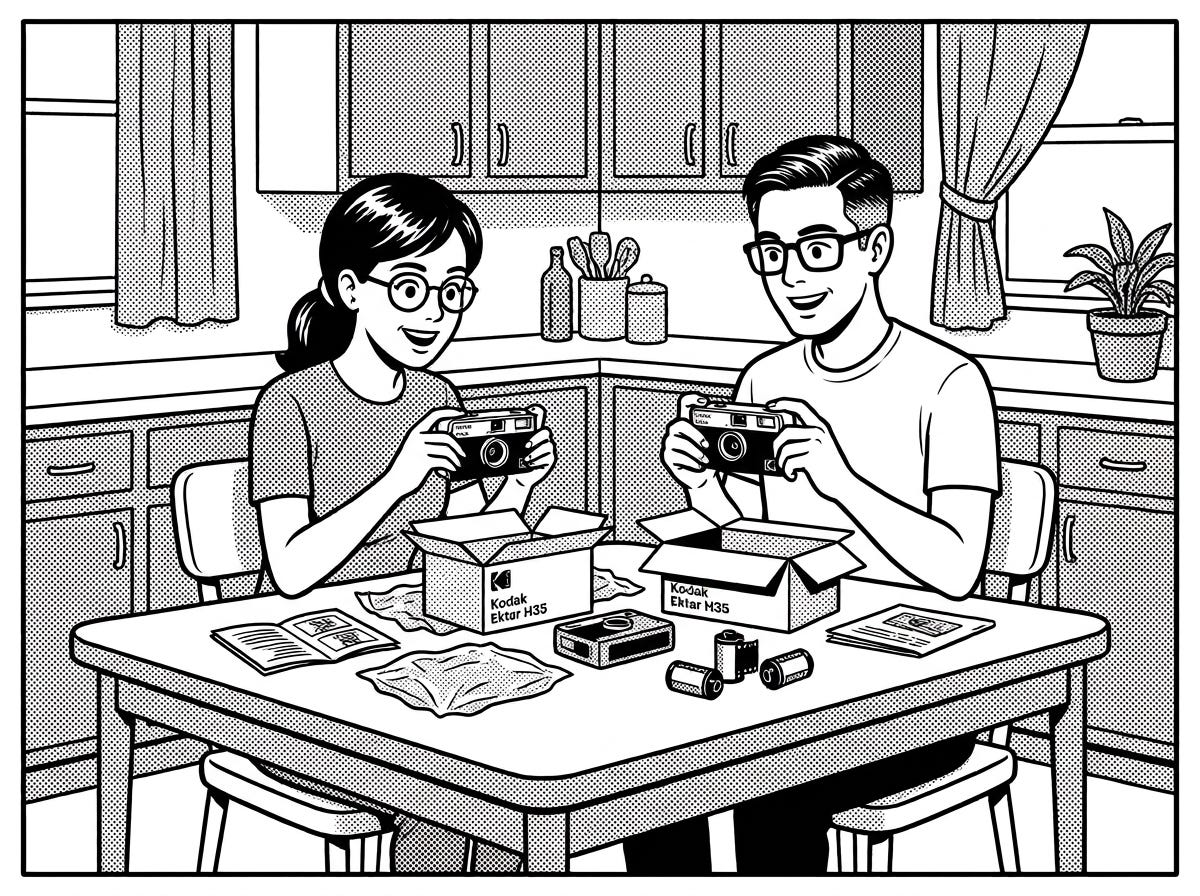
But now, the pictures I take will no longer be an imitation of film. I’m actually shooting on film. Also, purchasing two of the Kodak cameras brand new (one for me and one for my husband) was STILL cheaper than getting the one used Olympus camera. It gives both of us an opportunity to try out film photography without making a big investment upfront. And we decided that we should each have one so that we don’t interfere with one another’s creative flow when we actually go out to shoot. The cameras were delivered today, and I’m really excited to share how it goes.