
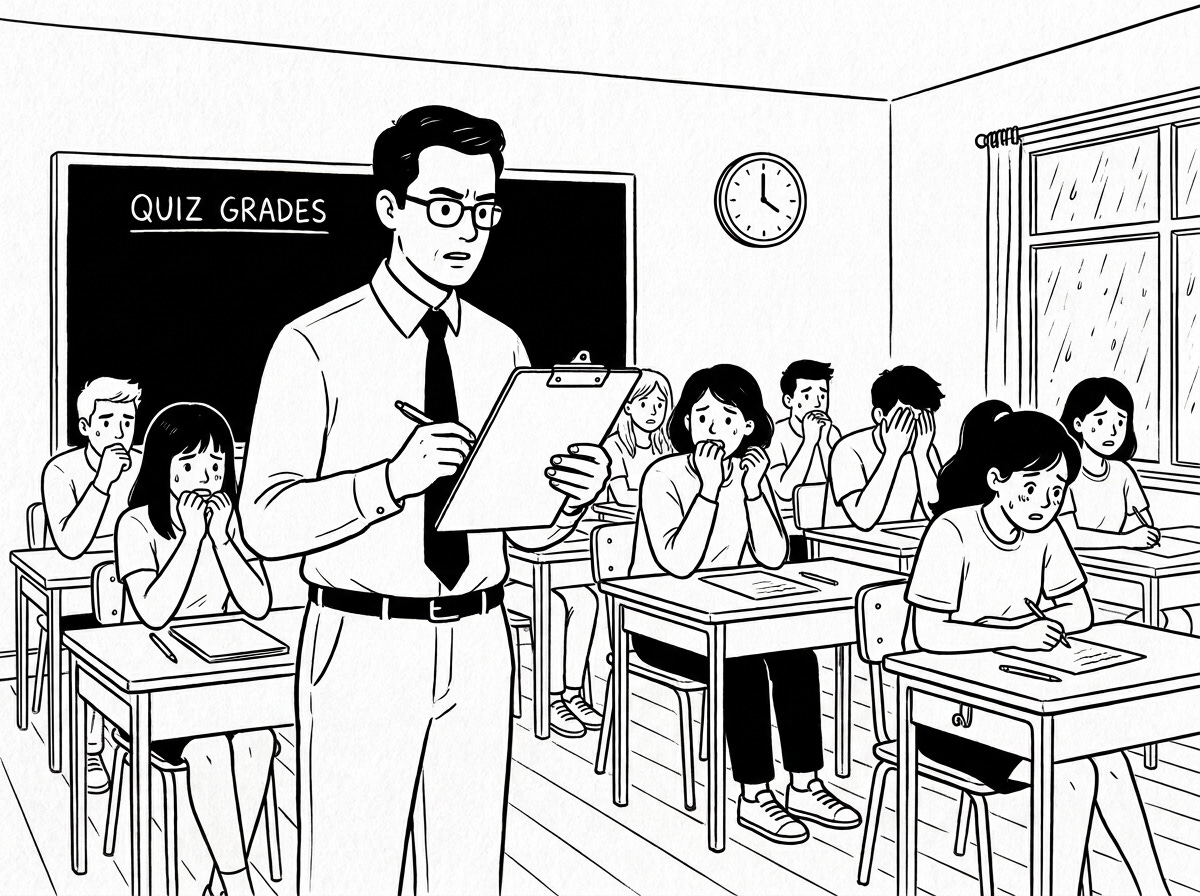
When I imagine a leader deliberately making an example of someone so the rest of the group falls in line, my honest reaction is that it makes me uncomfortable. The coldness of using one person to send a message to everyone else and the idea of people working scared both bother me. But if I had to pick the one that troubles me most, it’s the second — fear as a climate rather than a one-off. Being made an example of is a single moment. A team that runs on fear is a condition people wake up into every day.
What Fear Does in a Classroom
Fortunately, I can’t say I’ve been on a work team that made me feel that kind of continuous dread. But it does take me back to the school environment. Teachers are responsible for leading their students and helping them reach the goal of passing the class. I remember being in a class where, after a quiz, each student’s grade would be read out loud in front of everyone. If you didn’t do well, the whole class knew. I imagine the teacher was trying to motivate us to study hard, which I understand. But I did not agree with the method of putting everyone on the spot and embarrassing those who didn’t perform the way they’d hoped to. True, a poor result could’ve been the consequence of irresponsible behavior (e.g., staying up late, partying too hard, etc.). But that’s not always the case. A student could’ve legitimately been struggling to understand a specific topic that week, and now, instead of feeling like they can go get help, they’re stuck in a constant state of fear that they’ll have an off week and risk humiliation.
Here’s what that example clarifies for me. The teacher’s goal wasn’t the problem. Motivating people to study is a goal I actually agree with. The problem was who the fear caught in its net — the kid who was studying and still struggling, who in that moment looked no different from the kid who partied too hard.
Why Care Outperforms Fear
Someone could push back and say the teacher can’t see inside each student’s week, can’t know who tried and who didn’t, and that the public grade-reading isn’t aimed at the earnest student anyway. It’s aimed at the one who could do better and isn’t. And if a few hardworking kids get stung into working even harder, the class performs better overall. I understand that argument. But ultimately, what drives a person to put their best foot forward is actually caring about the matter at hand. If someone works hard solely out of fear of negative consequences, where’s the true fulfillment in living that way? The classroom is meant to prepare students for the real world, and yes, in the real world there are negative consequences we actively try to avoid. But there’s also the part where we want to be happy. If we’re hardwired to constantly live in fear, with an avoidant mentality instead of a proactive one, how does that lead to happiness?
And I’d argue care is both kinder and more effective than fear. The teacher already knows each student’s score. If some did poorly, they can be proactive and speak to those students discreetly to find out why, then offer either the help to understand the subject or the encouragement to put in more time. That preserves the student’s dignity while still holding them to a standard. It also trains them to take ownership of what they want to achieve. Students know when a teacher genuinely cares about them, and that is a far better motivator than being afraid.
What About the Person Who Doesn’t Care?
But someone could say I’ve picked the easy case — a room of kids who mostly want to please a teacher they like. What about the person who genuinely doesn’t care, and won’t, no matter how much warmth you extend? It all goes back to taking responsibility for what we want to accomplish. I don’t think it’s ever a bad idea to show a group you care about them, even if they don’t feel the same way yet. Who doesn’t want to feel like they matter? But if a leader gives their best effort to motivate from a place of care and some still refuse to budge, that’s where healthy boundaries and consequences come in.
Say a team is given a project that’ll take a considerable amount of time. You have high performers and people who couldn’t care less. A healthy boundary is a reasonable timetable and regular check-ins — chances to see where everyone’s at, offer help without doing the work for them, and notice any shift in attitude. If, by the end, some stubbornly refuse to change, then they’ll have to deal with the consequences. When a leader has done their part, there comes a point where they have to let people live the way they’ve chosen, because those people are still responsible for their own lives.
Where the Line Falls
Now, a critic could say I’ve just smuggled fear back in through the word “consequences.” After all, people behave at those check-ins because they can anticipate what’s waiting if they don’t, and adjusting your behavior to avoid something you dread is fear wearing a more respectable outfit. So where’s the actual line?
For me, the line is what’s actually needed to achieve the result. Is it necessary to embarrass someone to motivate them? No. Someone can be encouraged to make better choices, or get additional help, with their dignity intact. Fear will always be involved to some degree. There will always be consequences for our actions, good or bad. But leaders have the option not to exploit that fear, not to manufacture dread beyond what the goal genuinely requires. The manner in which they lead and communicate makes all the difference in sustainably achieving their goals, and continuing to achieve them.
The Cost Belongs to the Leader
I have to be honest about the hardest version of this, though. Under real pressure — a slipping deadline, high stakes, the humane approach not working — sticking to that line is genuinely difficult. I can’t pretend otherwise. But I also can’t just point the finger at others. In that scenario, I’ve chosen to take on the leadership role, and that comes with high-stakes consequences of its own. If the methods I chose fail to lead my team successfully, then I need to take responsibility for my own failures and bear the brunt of not delivering what was expected of me.
That’s where I land. The struggling student should own their outcomes. The stubborn team member has to live with theirs. And the leader absorbs the cost rather than exporting it downward as fear. The person with the most power should carry the most weight, not the least. That, to me, is the line between necessary consequence and manufactured dread, and it’s the one I’d want to be held to if the group were ever mine.