
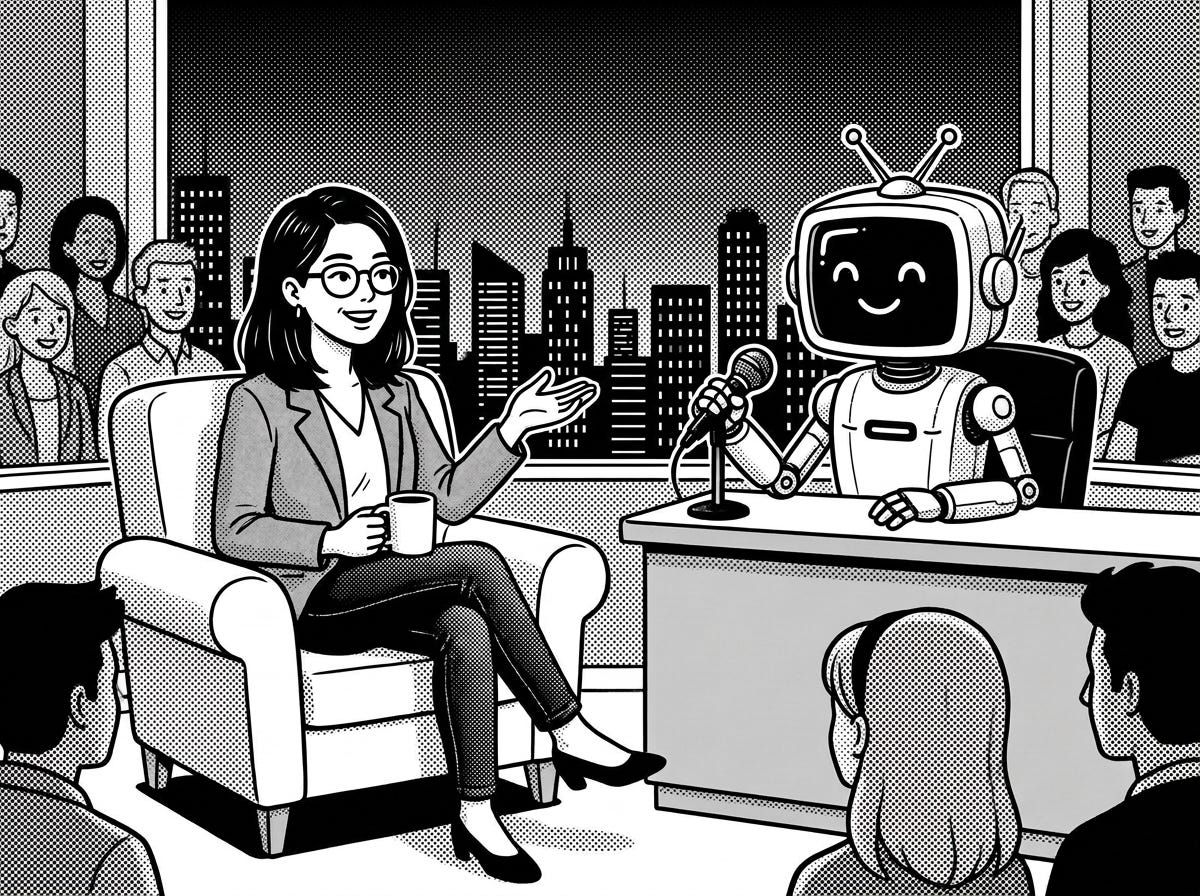
CLAUDE: You’re writing a newsletter that goes out under your own name. Has there been a specific moment where AI handed you a line that was better than the one you’d written yourself — and what did you do with it?
ME: I can’t think of a specific line at the moment, but I definitely feel like AI has been helpful when it comes to assisting me with my writing process. There are days when I’m just mentally exhausted or physically unwell (like I was last week), and AI has helped with getting ideas flowing or thoughts organized so that the piece as a whole sounds more cohesive. Even this interview right now is pushing me to think deeply about the subject I’m being questioned about.
CLAUDE: Take me back to last week. On a day you were unwell, what did you actually hand over to the AI that you wouldn’t have handed over on a good day?
ME: I handed over to AI the task of organizing everything I brain dumped onto a Word document that day and putting together a draft for a newsletter issue. I still scrutinized every sentence and did my best to revise (or even completely remove) any parts that didn’t sound like me, so I did the necessary work of editing. But normally, I prefer to go through the entire process from beginning to end on my own, which includes writing the first draft from scratch based on the material I’ve brainstormed.
CLAUDE: When you were scrutinizing that draft, was there anything you kept that you’re not entirely sure you’d have written on your own?
ME: There were certainly some expressions or ways of saying things that I wasn’t completely sure I would’ve been able to come up with on my own, but the main ideas (and even the details) were mine. I fed them to the machine, so what it spit out wasn’t too far off from what I would’ve written to begin with. Admittedly, though, I did like some of the specific wording that AI suggested, so I decided to keep it even if I didn’t come up with every single word myself.
CLAUDE: Someone reading that might say the wording is the writing — that ideas are cheap and what a reader actually experiences is the sentences. If that’s true, keeping the machine’s phrasing means the part readers meet isn’t fully yours. What would you say to that?
ME: I’d say I can understand that viewpoint. I’m all for protecting my own voice and being authentic. However, I would also argue that the intent behind the work matters too. Like any other type of artist, writers also want to improve in their skills. This often involves drawing inspiration from other written pieces that they connect with and want to emulate (not plagiarize), so they will inevitably read the work of others. It could also involve expanding their vocabulary, and in order to do that, they would need to consult a dictionary or a thesaurus to give them a variety of ideas. AI can be used as a tool to accomplish the same goal. While the aim is not to sound like a machine, the technology can provide inspiration that a writer resonates with and will want to implement their own work.
CLAUDE: A thesaurus gives you options and you pick one. AI gives you a finished sentence and you approve it. Is that the same act, or a different one?
ME: It’s only a different act if you read the finished sentence and approve it without thinking about (or looking up) whether there are better ways to say what you intend to say. You can also prompt AI to give you other potential options if what it initially suggested doesn’t feel true to you. It all depends on how you utilize the tool, not just the way many typically choose to use it.
CLAUDE: That standard depends entirely on you catching yourself in the moment. On a day when you’re exhausted and unwell — the exact day you’d reach for the tool most — how do you know you’re still meeting it?
ME: I think that’s where self-awareness comes in. I need to be honest with myself about whether or not I’m actually meeting the standard I’ve set for myself. I’m confident that, at least for the most part, I’d know deep down if I truly did my best or if I caved and resorted to going the lazy route.
CLAUDE: Has there been a day where you caved?
ME: Admittedly, yes. It was actually before I started writing my newsletter. I was using AI to write semi-lengthy social media text posts for me. When I look back on them, I feel like it’s obvious that the posts were following a formula (which I outsourced to AI to work within the confines of), and even though the ideas were technically mine, I wasn’t doing nearly enough quality control when it came to the specific content that the AI was spitting out.
CLAUDE: What made you stop?
ME: It was a combination of things. One was seeing all the comments and posts in my feed about the telltale signs that something was written by AI, and while all of those need to be taken with a grain of salt, they did still get me thinking about the quality of my own writing. I also realized that I didn’t want to get to the point of outsourcing my thinking. I wasn’t there yet, but I saw how I could’ve easily gotten there had I continued what I was doing. Finally, I was reminded of why I fell in love with writing to begin with. It was a form of self-expression, and I thoroughly enjoyed the entire process. Even if I were to utilize tools that would help me to improve in my skills, I still want to be able to walk away genuinely feeling like the words were my own.
CLAUDE: Those old posts are still up, presumably. Do you leave them there?
ME: I actually took them down. I want everything I put out there to be something I can get behind. Even if they’re cringy, at least I can wholeheartedly say they’re mine.
CLAUDE: You took down posts whose ideas were technically yours because the words weren’t. The newsletter issue from last week also has wording in it that you didn’t come up with — and that one’s still out there. What makes one keepable and the other not?
ME: Last week’s newsletter met the standard I set for myself. The old posts did not.
CLAUDE: Try to put that standard into words. Not as a principle — as a test you could actually run on a paragraph.
ME: I would ask myself the following questions: 1) How does the version drafted by AI compare to the original brain dump? Are my thoughts and word choices in tact, or does it sound like a completely different person? 2) If there’s phrasing or a word choice suggested by the AI that you genuinely like and want to keep, is it something you would’ve come up with on your own? If not, have you thought of (or looked up) other ways to potentially say the same thing before landing on your final choice?
CLAUDE: Your second question asks whether you’d have come up with the phrase on your own — but you said earlier the appeal is that sometimes you wouldn’t have. What does a “no” actually disqualify?
ME: The “no” doesn’t disqualify anything. Rather, it triggers the follow-up question that makes me go through the process of learning and improving my skills rather than lazily accepting the first option that’s presented to me.
CLAUDE: So the test isn’t about where the words came from — it’s about whether you did the work of choosing. What happens to that standard when you’ve been writing this newsletter for two years and the choosing has become automatic?
ME: If I’ve been choosing from options in my own brain and not from tools like AI, then I can feel good about the fact that I’m growing in my ability as a writer. The standard would just be to keep improving. I can rinse and repeat the original process, but with different expressions and word choices.
CLAUDE: One more. You’ve been describing this as a discipline you hold yourself to privately — nobody’s checking. Does your reader deserve to know any of it, or is that between you and the work?
ME: I don’t think I owe it to the reader to share what I do, but I am choosing to share it anyway because it’s real, honest, and something I can get behind even if I cringe when I look back on it down the road.